Wedding Clients: 5 Questions to Ask About Beauty Travel Fees
A beauty travel fee covers the cost of a hair or makeup artist getting to you, plus their gas, parking, tolls, and time on the road. Local trips usually run $0 to $75. Regional bookings tend to fall between $50 and $300 depending on distance. Destination or overnight events can push $250 to $600 or more once lodging enters the picture. Every artist prices it a little differently.
TL;DR:Local travel fees usually range from $0 to $75, with many artists waiving them within a 10 to 15-mile radius.Regional trips of 30 to 60 miles typically add $50 to $150, while longer trips or multi-location days can cost $150 to over $300.Destination or overnight bookings often start at $250 and can exceed $600 once lodging, flights, and per-diem costs are included.Travel fee calculation methods include mileage-based, time-based, flat-tier, and hybrid models, which should match the trip’s complexity.Extra charges like parking, assistants, early start surcharges, tolls, and venue access costs are frequently added, and clear itemization helps compare quotes effectively.
VÉLOURA Beauty On DemandBring Wedding Beauty to Your VenueVÉLOURA connects wedding clients with licensed, vetted professionals for hair, makeup, nails, lashes, and skincare at their location.Explore mobile beauty services
Table of Contents
- What Are Typical Beauty Travel Fee Ranges?
- How Do Artists Calculate Travel Fees?
- What Else Gets Added to a Beauty Travel Fee?
- How Do Destination Weddings Change the Travel Fee?
- What Should You Ask Before Signing a Travel Fee Agreement?
- How Do You Budget and Negotiate Travel Fees?
- How VÉLOURA Handles Travel Fees and Booking Transparency
- A Makeup Artist’s Perspective on Travel Realities
- Book Mobile Beauty Services With Transparent Travel Pricing
- Sources
- FAQ
What Are Typical Beauty Travel Fee Ranges?
The number on your quote depends almost entirely on distance and logistics, not on the artist’s skill level. Understanding what typically shows up at each distance band helps you spot a fair price versus an inflated one.
Same-day, local bookings, meaning artists working within their home base or a short drive, often come with no travel fee at all. Many professionals waive it inside a set radius, commonly 10 to 15 miles, because the trip barely dents their schedule. When a fee does apply locally, it usually lands between $0 and $75.
Short regional trips change the math. A one-way drive of 30 to 60 miles typically adds $50 to $150 to your invoice. That range accounts for gas, wear on the vehicle, and the chunk of the artist’s day that travel eats up, even before they touch a makeup brush.
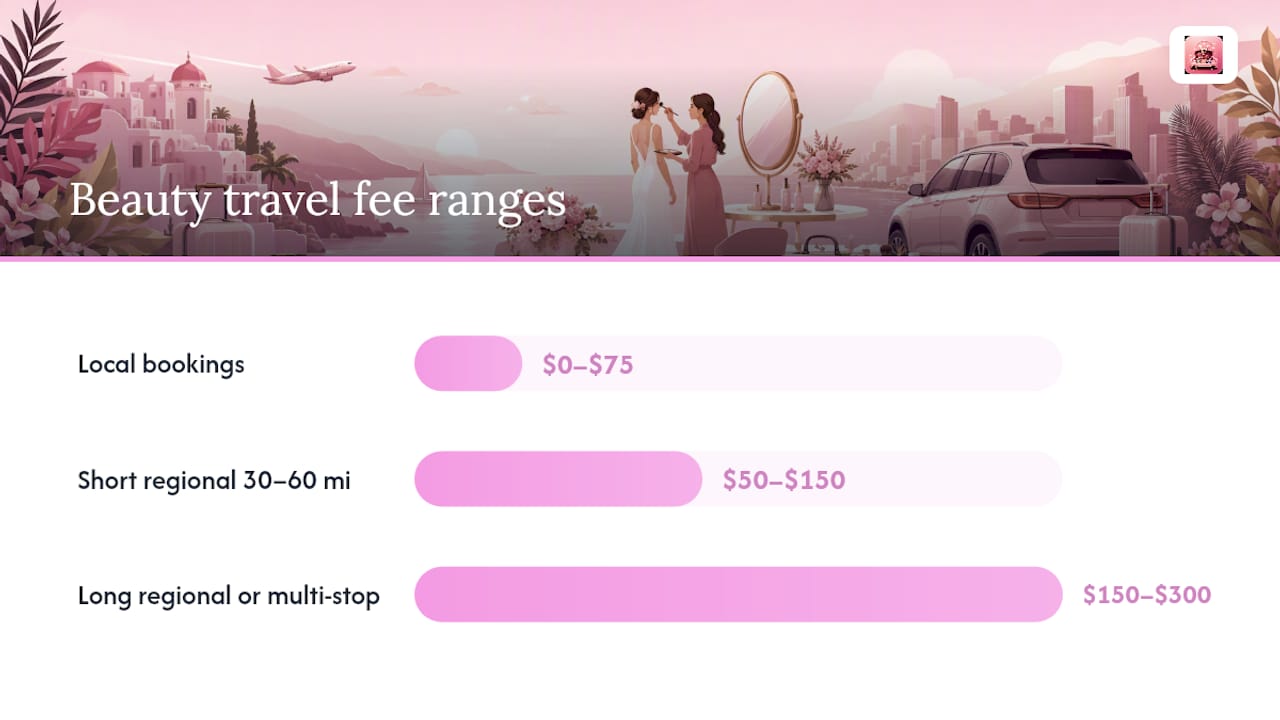
Longer regional jobs or days with multiple stops (say, a bridal party split across two locations) commonly run $150 to $300. This is where hybrid pricing tends to appear, since a flat mileage rate stops making sense once an artist is managing several addresses and a tight morning timeline.
Destination and overnight bookings sit in a different category entirely. Fees here commonly start around $250 and climb past $600 once lodging, flights, or per-diem meals enter the equation. At this level, travel fees exist to cover non-billable logistics like time, fuel, lodging, parking, and tolls, not the actual beauty service itself.
A few patterns worth knowing before you compare quotes:
- Artists often bundle small costs (tolls, parking) into a flat local fee rather than itemizing each one.
- Destination trips are far more likely to be itemized line by line, since the total swings so much.
- A fee that seems high for a “local” booking may signal the artist is quietly outside their normal service area.
- Wedding season weekends (particularly October, historically one of the busiest bridal months) can push regional fees toward the top of their range simply due to demand.
If a quote falls well outside these bands in either direction, ask what it includes before assuming it is unfair. A detailed breakdown of on-site bridal makeup costs shows how travel fees interact with the total price of the service itself, which matters more to your budget than the travel line alone.
How Do Artists Calculate Travel Fees?
Four calculation methods dominate the industry, and each one tells you something about how the artist thinks about their time and costs.
- Mileage-based pricing charges a set rate per mile, calculated round-trip from the artist’s base. Common travel fee structures include mileage-based charges, time-based fees, flat surcharges, and lodging or per-diem for overnight work, and most artists using mileage rates set a minimum fee so a five-mile trip doesn’t get priced at pocket change.
- Time-based pricing charges per hour of travel rather than per mile. This model makes more sense in dense cities where five miles can mean forty minutes in traffic. An artist working in a congested metro area often prefers this because mileage alone would badly undercharge them for their actual time lost.
- Flat-rate tiers group destinations into distance bands, like “0 to 20 miles: $50” or “20 to 50 miles: $125.” Artists who work the same venues repeatedly (a favorite hotel, a popular vineyard) often settle into flat tiers because they already know the real cost of getting there.
- Hybrid models combine two of the above, often a flat base fee plus mileage beyond a certain radius. These show up most on quotes for larger bridal parties or multi-location days, where a single flat number would not capture the added complexity.
None of these methods is inherently better. The right question is whether the method matches the job. A flat tier for a well-known wedding venue is reasonable. The same flat tier applied to a random residential address forty minutes outside the city deserves a second look.
What Else Gets Added to a Beauty Travel Fee?
Line items beyond simple distance are where quotes start to diverge, and where you should ask the most questions.
- Parking and valet fees at hotels and event venues are frequently passed through directly, especially in cities where daily parking runs $30 or more.
- Assistants get added to the travel line when a bridal party is large enough to need a second set of hands. If your booking includes six or more people getting hair and makeup done, expect an assistant fee bundled somewhere in the quote.
- Early starts before 6 AM, common for weddings with afternoon ceremonies, sometimes carry a surcharge since the artist is sacrificing sleep and possibly driving in the dark.
- Tolls and shuttle costs for venues without direct road access, like island properties or gated estates, get added when they are unpredictable enough that a flat fee wouldn’t cover them fairly.
Pro Tip: Ask whether “travel fee” on your quote is a bundled number or an itemized one. Bundled quotes are simpler to compare but harder to negotiate down; itemized quotes let you see exactly where your money goes and ask about any single line that looks off.
How Do Destination Weddings Change the Travel Fee?
Overnight and destination bookings shift the entire cost structure because the artist is now committing a full day, or several, exclusively to you.
Flights and hotel rooms become reasonable requests once a booking crosses a certain distance threshold, typically anywhere requiring a flight or a drive of several hours each way. Many artists set minimum travel fees for short trips and add overnight accommodation costs for longer drives, often with specific thresholds like a flat rate for a 1.5 to 2 hour drive and a higher tier once the trip exceeds four hours.
Two billing approaches show up for multi-day work; a wellness-focused beauty enhancement step-by-step guide offers complementary advice on practical beauty preparation and self-care.
- Day-rate billing pays the artist a flat amount for holding the entire day, regardless of how many looks they complete.
- Per-look billing charges by the individual service, which can work out cheaper for smaller parties but costs more once a bridal party grows.
Per-diem or meal allowances round out the destination quote. These are typically modest, covering meals during travel days, but they belong in writing rather than left as a verbal understanding, since destination bookings tend to accumulate the most disputed expenses after the fact.
What Should You Ask Before Signing a Travel Fee Agreement?
A few direct questions before booking save you from surprises on the final invoice.
- Is the fee charged round-trip or one-way? Most artists bill round-trip, since they have to drive home too, so a one-way-only fee that still feels expensive deserves a follow-up question.
- Does the quote include parking, or is it reimbursed separately? Get this in writing rather than assuming.
- Are tolls bundled into the flat fee, or billed as incurred? Ask for an estimate either way.
- Can you request an itemized quote? Breaking down travel costs into clear line items, rather than one lump number, reduces client objections and gives you something concrete to compare against other vendors.
- What does the contract say about caps and refunds? A solid contract states the fee basis, sets a maximum for reimbursable expenses, and spells out what happens to the travel fee if the event is canceled or postponed.
Ask for receipts on any variable expense (parking, tolls, mileage over an estimate) so your final invoice matches what was actually spent, not just what was quoted.
How Do You Budget and Negotiate Travel Fees?
Treat the travel fee as its own line item in your wedding or event budget, separate from the cost of the actual hair and makeup service. This makes it far easier to compare two vendors whose total quotes look similar but break down completely differently.
A few situations make it reasonable to ask for a reduced or waived fee:
- Booking a large bridal party, since artists commonly bundle small travel costs into one flat fee once they’re already making the trip for multiple clients rather than one.
- Choosing an off-peak date or day of the week, when an artist has more flexibility to absorb a shorter trip.
- Booking a venue the artist already visits regularly, where their real travel cost is lower than their standard quote reflects.
Tipping norms don’t change because a travel fee applies. Gratuity is still typically 15 to 20% of the service cost, calculated separately from travel. If your budget is tight, ask about consolidating appointments into one location rather than asking for a discount. A single venue for the whole bridal party often reduces travel costs more effectively than negotiation ever could.
How VÉLOURA Handles Travel Fees and Booking Transparency
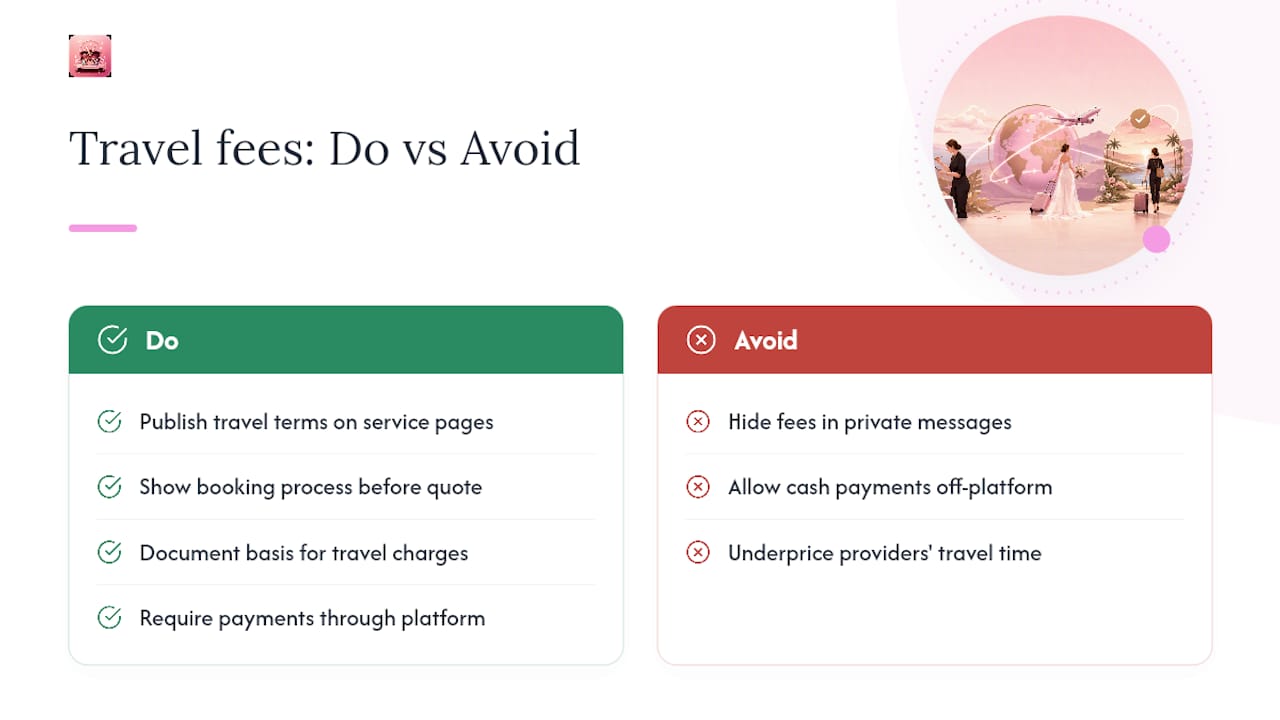
Some platforms list travel guidance directly on their service pages, so pricing structure isn’t a surprise buried in a private message thread. Clients requesting hair, makeup, or bridal services can often see how bookings work before committing to a quote.
Platforms that publish travel terms upfront tend to see fewer disputes at checkout, largely because clear, visible policies reduce the friction and back-and-forth that usually happens when a fee shows up unexpectedly.
Transparent travel terms matter on a marketplace model for several reasons, including providing documented bases for charges, protecting independent providers from underpricing their time and expenses, and enabling secure payments through the platform rather than separate cash arrangements.
A Makeup Artist’s Perspective on Travel Realities
Travel fees rarely reflect greed. They reflect a 4 AM alarm, a car packed with a full kit, and gas money that never shows up on the invoice for the actual makeup application. Charging for travel is standard practice in this industry, and most artists would rather be upfront about it than pad the service price to hide it.
One thing that consistently helps: consolidate every appointment into a single location. It cuts the travel fee and gives your artist more time in the chair with you.
Book Mobile Beauty Services With Transparent Travel Pricing
Comparing quotes from independent artists means comparing fine print, too, since travel terms vary from one professional to the next with no shared standard. VÉLOURA Beauty On Demand solves that by listing travel guidance directly on its service pages, so you see how pricing works before you request a quote.

Every booking runs through vetted, background-checked professionals, with secure in-app payments and itemized service details instead of a vague number texted the night before your event. For weddings specifically, the wedding beauty services page walks through how bridal party bookings and multi-person appointments are priced. If your event involves several people getting hair and makeup done, that page is the fastest way to see real numbers instead of estimates. Browse the makeup services page to review travel policy details for your area and request a quote before you lock in a date.
Sources
- Travel Fees for Makeup Artists: What to Expect and How to Budget
- How to Charge for Travel as a Bridal Hair and Makeup Artist
- Understanding Makeup Artist Travel Fees | Makeup by Diana
- Makeup Artist Travel Fee: How To Set & Communicate It To Clients
FAQ
What Is a Normal Travel Fee for a Makeup Artist?
A normal local travel fee runs $0 to $75, with many artists waiving it entirely within a short radius of their base. Regional trips of 30 to 60 miles typically cost $50 to $150, while destination bookings can exceed $250 once lodging is involved.
What Should You Charge for a Travel Fee (as a Client Evaluating a Quote)?
A fair quote reflects actual distance, time, and any added logistics like parking or an assistant, not a flat guess. Ask for an itemized breakdown showing mileage, time, or a flat-tier basis so you can judge whether the number matches the trip.
How Much Does a Full Makeover at a Beauty Counter Cost Compared to a Mobile Artist?
Counter makeovers at beauty retailers vary by location and service level, and pricing is best confirmed directly with the specific retailer since it changes frequently. Mobile services add a travel fee on top of the service cost, but they eliminate the commute and let you get ready in your own space.
Does VÉLOURA Beauty On Demand Charge a Travel Fee?
Travel pricing details for VÉLOURA Beauty On Demand bookings appear directly on the relevant service pages, where you can review current terms before requesting a quote. Pricing depends on your location and the specific service booked.
Is It Normal to Negotiate a Travel Fee?
Yes, especially for large bridal parties, off-peak dates, or venues an artist already visits regularly. Consolidating everyone into one location is often more effective than asking for a straight discount, since it reduces the artist’s actual travel burden.
Recommended

Comments ()