How Beauty Service Radius Works: A Client's Guide
TL;DR:A beauty service radius is based on drive-time, not miles, and it divides into core, standard, and extended zones. These zones determine booking options, pricing, and provider availability, with proximity and local reviews influencing search rankings. Proper understanding of these zones helps clients find reliable appointments and avoids unrealistic expectations about service coverage.
A beauty service radius is the defined geographic area where a mobile beauty professional can operate efficiently, profitably, and without sacrificing service quality. Understanding how beauty service radius works tells you exactly why some providers appear in your search results and others don’t, and why a pro two miles away might still be unavailable to you. Platforms like VÉLOURA Beauty On Demand build their entire booking logic around these boundaries. The radius isn’t just a map setting. It’s an operational decision that shapes your booking options from the moment you open an app.
How is a beauty service radius determined?
Service radius is not simply a circle drawn around a provider’s address. The industry standard measures drive-time, not miles, because a five-mile trip through downtown Los Angeles can take 45 minutes while a ten-mile trip on a freeway at 7:00 AM takes fifteen. That gap matters enormously for a mobile beauty professional managing back-to-back appointments.

A geometric circle on a map ignores rivers, highways, bridges, and traffic patterns entirely. Drive-time polygons, called isochrones, trace the actual roads a provider can travel within a set time window. The result is an irregular shape that reflects real conditions, not an idealized circle. A provider based in Miami Beach, for example, might cover a wide area to the west but a narrow strip to the south because of water barriers.
Industry standards target 25–40 minutes of one-way travel time as the standard pricing threshold. Travel beyond that window typically triggers a surcharge or a booking restriction. This keeps the provider’s schedule profitable and prevents a single long-distance appointment from wiping out two shorter ones.
Several factors shape where the boundary actually falls:
- Road infrastructure: Bridges, tunnels, and highway access points create hard limits on how far a provider can realistically travel.
- Traffic patterns: Rush-hour congestion in New York City or Los Angeles can cut a service zone in half during peak hours.
- Appointment density: Providers often extend their radius when multiple clients in the same area book on the same day, making the longer trip worthwhile.
- Service type: A blowout takes 45 minutes. A full balayage takes three hours. Longer services justify longer travel.
Pro Tip: When you book a mobile beauty service, check whether the provider lists travel fees. A fee structure that increases beyond a certain distance is a reliable signal that you’re near the edge of their core service zone.
What are the typical operational zones within a beauty service radius?
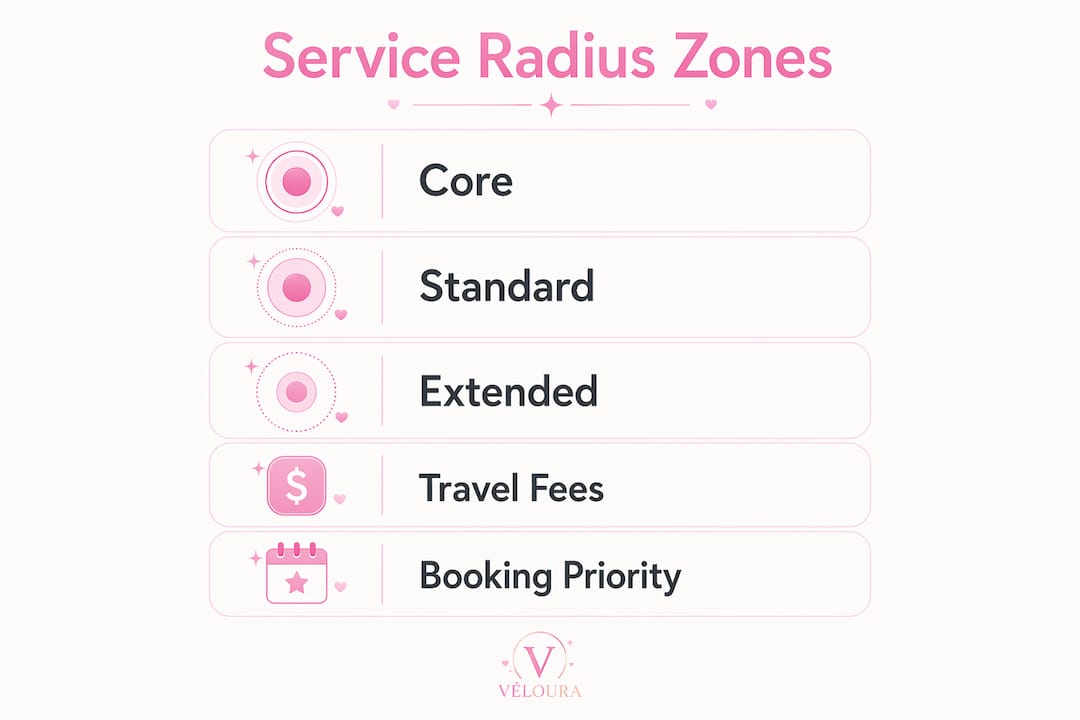
Mobile beauty providers don’t treat their entire service area as one flat zone. Service areas divide into three operational tiers: core, standard, and extended. Each tier carries different availability, pricing, and scheduling rules.
- Core zone (0–15 minutes travel): This is the provider’s most profitable area. Appointments here are easiest to schedule back-to-back, require no travel surcharge, and get first priority when the calendar fills up. If you live within this zone, you’ll almost always see the widest selection of available time slots.
- Standard zone (15–40 minutes travel): This is the main service area for most mobile beauty professionals. Providers may batch appointments here, grouping two or three clients in the same neighborhood on the same day to make the trip efficient. A small travel fee may apply, and same-day availability can be tighter.
- Extended zone (40–60 minutes travel): Jobs over 40 minutes one-way are typically reserved for high-value bookings or clustered appointments. Bridal parties, corporate events, and hotel groups often fall into this category. Expect a clear travel surcharge and reduced spontaneous availability.
| Zone | Travel Time | Typical Pricing | Booking Priority |
|---|---|---|---|
| Core | 0–15 min | Standard rate | Highest |
| Standard | 15–40 min | Standard + possible fee | Moderate |
| Extended | 40–60 min | Standard + travel surcharge | Selective |
Understanding which zone you fall into explains a lot. If you’re booking a last-minute blowout and the only available pros are in your extended zone, the limited slots and higher price make sense. The provider isn’t being arbitrary. They’re protecting their schedule.
Pro Tip: Book services for groups or events at least a week in advance if you’re in a standard or extended zone. Providers prioritize clustered bookings in those areas, so early scheduling dramatically improves your chances of landing a preferred time.
How do online platforms define and display mobile beauty service areas?
Platforms moved away from crude radius circles years ago. As of 2026, providers define service areas using city names, postal codes, or counties rather than a simple mileage ring. This shift reflects how clients actually search: by neighborhood or zip code, not by distance from a pin.
Platforms allow up to 20 distinct geographic designations per provider profile. A mobile nail technician in Los Angeles might list Beverly Hills, West Hollywood, Culver City, and Santa Monica as separate service areas. Each designation signals to the platform’s algorithm that the provider is genuinely available there.
The way a provider sets up their profile directly affects what you see when you search. Key platform mechanics include:
- Address-anchored visibility: The platform uses the provider’s verified base location as the starting point for proximity calculations, even if the provider serves a wide area.
- Declared service zones: Providers list specific cities or zip codes to appear in searches for those locations.
- Hybrid profiles: Hybrid business profiles show both a physical address and a defined service area. This gives providers the visibility benefits of a fixed location plus the reach of a mobile service.
- Penalty for over-claiming: Google reduces visibility for providers who claim implausibly large areas without matching local reviews or engagement. A provider listing 50 zip codes across three counties will likely rank lower than one with 10 tightly defined zones and strong local reviews.
Google Business Profile advises that service areas reflect actual travel distance, with a general maximum of two hours. That guideline keeps provider profiles credible and prevents the kind of over-claiming that hurts both the provider’s ranking and your search results. For clients, this means the professionals who appear at the top of your search are genuinely able to serve you, not just casting a wide net.
Pro Tip: When you search for a mobile beauty provider, filter by your specific zip code rather than your city name. Zip code searches return more accurate results because providers list their zones at that level of specificity.
How does service radius affect booking options and discovery for clients?
Your location relative to a provider’s core zone is the single strongest factor in whether that provider appears in your search results. Proximity to the provider’s verified address outweighs broad service area declarations in dense urban markets. A provider who lists your neighborhood as a service zone but is based 35 miles away will rank below one based five miles from you, even if both technically serve your area.
Review volume reinforces this effect. Providers with strong local reviews in your specific area rank higher than those with generic reviews spread across a wide region. This is why a provider who regularly serves your zip code and has 50 reviews mentioning your neighborhood will almost always appear before a provider with 200 reviews spread across an entire city.
The practical impact on your booking experience looks like this:
- Fewer options in low-density areas: If you live outside a major metro, fewer providers operate in your zone, which limits both availability and service variety.
- Travel fees at zone edges: Clients near the boundary of a standard or extended zone regularly see travel surcharges added at checkout. These fees are not arbitrary. They reflect the real cost of the provider’s time.
- Tighter availability windows: Providers in your extended zone may only accept bookings on specific days when they’re already traveling to your area.
- Search ranking by proximity: Adding distant locations without local social proof leads to algorithmic suppression, which means fewer providers appear for your search even if they technically serve your area.
Understanding this dynamic helps you set realistic expectations. If you’re in a dense urban area served by VÉLOURA Beauty On Demand, you’ll see a wide pool of vetted professionals. If you’re at the edge of a service zone, you may need to book further in advance or consider flexible timing. Learning about mobile beauty time savings can help you decide whether the tradeoff is worth it.
What practical tips can clients use to navigate service area limits?
Knowing how the system works puts you in control of your booking experience. These steps help you find available professionals and avoid surprises:
- Search by zip code, not city name. Providers list their zones at the zip code level. City-level searches can return providers who technically cover your city but are based far from your specific neighborhood.
- Read the service area section on provider profiles. Most platforms display the specific cities or zip codes a provider serves. If your location isn’t listed, the provider likely won’t accept your booking or will add a significant travel fee.
- Book in advance for extended zones. Providers in your standard or extended zone often batch appointments. Booking three to five days ahead gives you access to slots that haven’t been claimed by clients in the core zone.
- Check for travel fees before confirming. Platforms typically display travel fees at the checkout stage. If you see one, you’re likely near or beyond the provider’s standard zone boundary.
- Factor in traffic and time of day. A provider who is 20 minutes away at 10:00 AM may be 45 minutes away at 5:00 PM. Some providers adjust their available booking windows based on expected traffic, which affects same-day availability.
Pro Tip: If your preferred provider isn’t available in your area, check whether they offer extended zone bookings for group services. Bridal parties and corporate events often unlock availability that individual bookings don’t.
For clients who travel frequently, city-specific mobile beauty options vary significantly by market. A service zone that works perfectly in Miami may look completely different in New York City because of infrastructure and provider density.
Key Takeaways
A beauty service radius is determined by drive-time modeling, not miles, and divides into core, standard, and extended zones that directly control your booking options, pricing, and provider availability.
| Point | Details |
|---|---|
| Drive-time defines the radius | Industry standards use 25–40 minutes of travel time, not miles, as the service boundary. |
| Three operational zones exist | Core (0–15 min), standard (15–40 min), and extended (40–60 min) zones carry different fees and availability. |
| Platforms use zip codes, not circles | Providers list up to 20 geographic designations; searching by zip code returns the most accurate results. |
| Proximity drives discovery | Your location relative to a provider’s base address is the strongest factor in search ranking. |
| Over-claiming hurts providers and clients | Large, unverified service areas trigger ranking penalties, reducing the professionals you see in search results. |
The radius reality most clients never consider
At VÉLOURA Beauty On Demand, we’ve seen a consistent pattern: clients who understand service zones book better and feel less frustrated. The ones who don’t often assume a provider is being difficult when they’re actually just being honest about what they can deliver well.
The uncomfortable truth about service radius is that bigger isn’t better. A provider who claims to serve an entire metro area is almost always overpromising. The quality of a mobile beauty service degrades when a professional spends two hours in traffic before touching a client. Rushed setup, fatigue, and compressed appointment times follow. A tightly defined zone isn’t a limitation. It’s a quality signal.
We’ve also noticed that clients in extended zones get the best experience when they book as part of a group. A bridal party in a suburb 50 minutes from a provider’s base gets full attention, premium service, and often a better rate per person than a solo booking would. The radius works in your favor when you use it intentionally.
Platforms are getting better at surfacing this information clearly. The shift from crude radius circles to zip code and city-based service area declarations has made provider profiles far more honest. When you see a provider on VÉLOURA Beauty On Demand with a focused, specific service area and strong reviews in your neighborhood, that’s exactly the combination you want.
— VÉLOURA
VÉLOURA Beauty On Demand and your service area
VÉLOURA Beauty On Demand builds its platform around realistic, clearly defined service zones so you always know who’s actually available near you.
Every professional on VÉLOURA Beauty On Demand lists their service area by specific cities and zip codes, not vague radius claims. You see real availability, real pricing, and real travel fees before you confirm. Whether you’re booking a blowout in Beverly Hills, lash extensions in Miami Beach, or bridal makeup in Manhattan, the platform matches you with vetted professionals who are genuinely within reach. Browse beauty services near you to see which licensed pros are available in your zone right now. You can also explore the full VÉLOURA on-demand app to book your next appointment in minutes.
FAQ
What is a beauty service radius?
A beauty service radius is the geographic area where a mobile beauty professional accepts bookings. It is defined by drive-time from the provider’s base location, typically 25–40 minutes one-way for standard pricing.
Why can’t I book a provider who is close to me?
Proximity by miles doesn’t always match drive-time proximity. A provider two miles away may be 45 minutes away by road, placing you outside their core or standard service zone.
Do travel fees always apply outside the core zone?
Travel fees typically apply when a booking falls in the standard or extended zone, beyond the provider’s 15-minute core area. The fee reflects the provider’s additional travel time and cost.
How do platforms decide which providers appear in my search?
Proximity to the provider’s verified address and review volume in your specific area are the strongest ranking factors. Providers who list your zip code and have local reviews rank above those with broad, unverified service claims.
Can a provider expand their service radius for group bookings?
Yes. Providers regularly extend into their standard or extended zones for high-value group bookings like bridal parties or corporate events, since the longer travel time becomes worthwhile when multiple appointments are clustered together.
Recommended

Comments ()